

St. James the Apostle

Un texte de Tyson Rosberg
Paru dans le numéro Printemps/Spring 2026
Publié le : 10 mars 2026
Dernière mise à jour : 12 mars 2026
The present St. James the Apostle church was completed in 1878, and is reminiscent of many church buildings found across rural England.
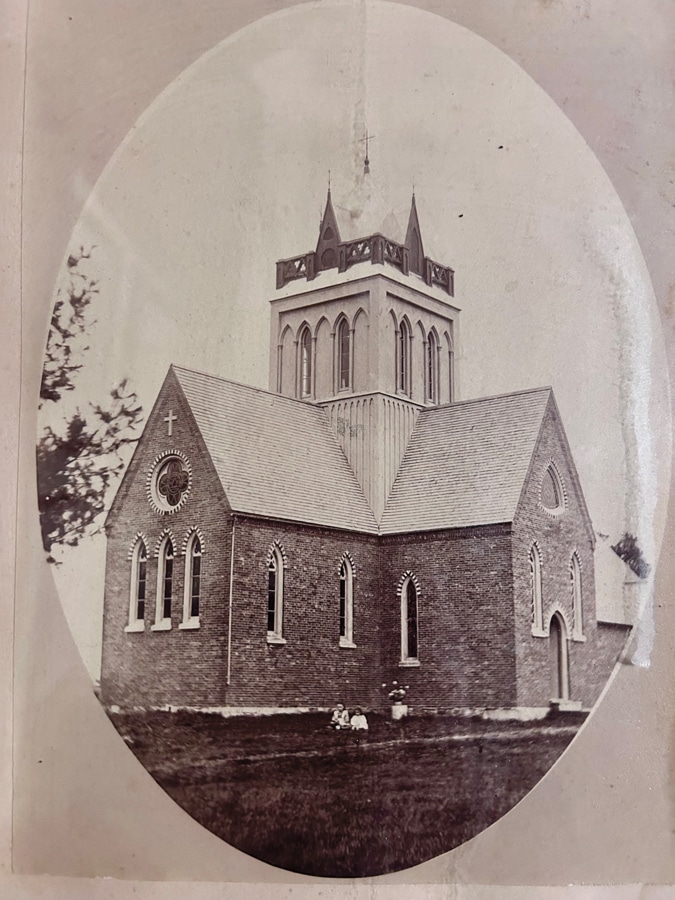
Prior to the construction of any church, the Rev. James Reid of St. Armand East (Frelighsburg) conducted the first Anglican services in Stanbridge East in an old schoolhouse building. Land was deeded by Robert Burleigh and James Scagel for the building of a proper church building in 1829, and construction began a year later.
The original church
It seems the original church was built of brick with a tower at the north end. The costs required for construction were raised through the renting of church pews (families paid to rent where they could sit on Sunday morning !).
A Mysterious Faith
Unfortunately, the new church quickly fell into disrepair. Reid noted in his journal: “The foundation of the church is giving way to the manifest danger of the edifice… if it is not repaired this fall, it will come down with a crash next spring.” Mystery and local legend shroud the church’s rapid decline.
Some suggest that political tensions decimated the congregation following the Rebellion of 1837. Many locals leaned towards the Patriote reformist Louis-Joseph Papineau who is said to have held a meeting on the steps of the church. Conversely, many of the Anglican clergy of the day held staunch loyalties to the Crown, and believed Stanbridge East to be a “stink-hole of rebellion.”
Others suggest that a lack of funds was responsible : between 1830 and 1835, the British government withdrew financial grants for the Society of the Propagation of the Gospel (SPG), a missionary group which many Anglican churches in Quebec were heavily dependent on. Previously, the Society helped pay clergy stipends and finance the general work of the Anglican Church in the region.
Still others claim sabotage as the reason for the building’s demise, with some not liking the architecture of the first church, and deliberately vandalizing it in order to necessitate a new construction!
The present church
Whatever the cause, the Rev. Isaac Constantine entered the scene in 1851. He was regarded to be a gentleman of high education, poetic talent, and above all, great determination. In 1861, Constantine began working towards the construction of a new church building, removing the pews to an adjacent shed where Sunday services could continue in the meantime.
The present church was completed in 1878, and is reminiscent of many church buildings found across rural England. Upon completion of the church, Constantine described the building as being “indeed, a very fine specimen of a village church.” Bishop James Fulford, the Anglican Bishop of Montreal, also called the church “The best I have seen in this country.”
The red brick building is an architectural gem amongst Anglican churches in the Eastern Townships—and the rest of Quebec. The church is in the shape of a cross (cruciform). It is built in the carpenter gothic style: identifying features of this style include steeply pitched roofs and gables, gingerbread ornamentation, and strong vertical design elements, all of which can be seen on St. James the Apostle.
St. James the Apostle continues to stand as a testament to architectural beauty and hard work at 13 Maple in Stanbridge East, Quebec.
The Rev. Tyson Røsberg