

Mary’s Pistol

Un texte de Heather Darch
Paru dans le numéro Printemps/Spring 2026
Publié le : 11 mars 2026
Dernière mise à jour : 13 mars 2026
Mary’s pistol is a fine example of a mid-19th-century woman’s firearm. It also represents the greater story about a devastating famine, the damaging political policies that came with it, and an extraordinary journey in one woman’s life.
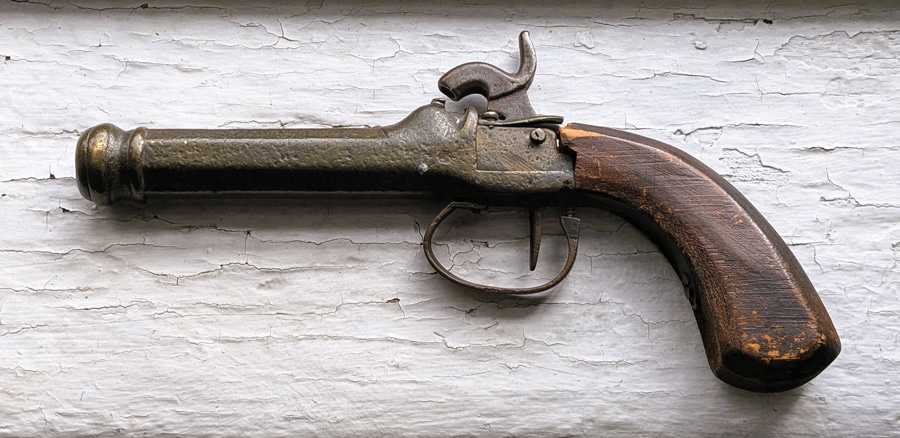
The collection catalogue indicated that a pocket-sized pistol housed in the Missisquoi Museum was once owned by Samuel Wickcliffe Sr. of St. Armand West. Surprisingly, though, this long-held “fact” gave way, when a local military historian and antique gun collector said with a grin, “It’s his wife’s gun!”
The smooth-bore, single-shot percussion black powder pistol, made in England between 1830 and 1850, was notably used by women for self-defence. Historically known as a “muff pistol,” it could be concealed in a skirt pocket, or in a cylindrical glove known as a muff used to keep hands warm. This little gun was ineffectual at a distance. But its discharge could startle an attacker, and the lead ball could cause severe damage or death when fired at close range.
Mary Tinnelly’s Story
Mary Tinnelly (1824–1899) from County Antrim, Northern Ireland, first appears in the records of Missisquoi County in the marriage register of the St. Armand Methodist Church. That was when she wed County Antrim native, Samuel Wickcliffe (1826–1897) in 1851. The census taken later that same year, indicates that they began their married life living in a single-storey frame house with another family and that Samuel worked as a “servant.” Their lives can be followed through subsequent census and church records, but their personal stories before this date are unknown. What is likely is that they made their way to Quebec in the 1840s and during the Irish Potato Famine.
The Potato Famine and Its Repercussions
In 1845, European potato fields were attacked by a pathogen called Phytophthora infestans. It was only in Ireland, however, that the blight’s devastation reached famine levels. The 1851 Irish census notes the disappearance of 1.5 million people. They had died in, or fled from, what the Irish called An Gorta Mór.It means the Great Hunger. The famine is considered to be “one of the costliest disasters of the 19th century in terms of its demographic impact and proportional population loss.”
The combination of the collapse of the potato harvest and the humanitarian catastrophe meant that two of every three people born in Ireland between the 1820s and 1830s, starved to death or became a part of the exodus to countries like Canada.
Both Mary Tinnelly and Samuel Wickcliffe joined this migration. As their names are not in the 1842 Lower Canada census, they probably arrived between 1843 and 1850. No evidence suggests that they came together or that Mary travelled with someone. In fact, it is plausible that she came to Quebec on her own.
Emigration : A Practical Solution For Women
The choice of emigration was considered a practical solution for single Irish women decades previous to the Great Hunger. During and after the famine, the social changes made this option even more desirable. The lack of economic and social gains meant that Irish women were encouraged to emigrate on their own and “turn their backs on the land of their birth.” By comparison to women in other countries at the same time, a distinguishing feature of Irish emigration was the large number of young single women who came to North America seeking their future independently of male family members.
The established shipping lanes between Ireland and Quebec made the option of leaving from Belfast, Northern Ireland an affordable option for Mary. That said, however, women travelling alone during the 1840s faced dangerous conditions aboard overcrowded and disease-ridden “coffin ships.” Conceivably amongst her belongings was the small pistol that gave her some measure of security against assaults or theft as she embarked on what was most certainly a terrible journey. Of the 110,000 who set out for Canada in 1847 for example, 20% died at sea from typhus, or in quarantine stations like Grosse-Île, Quebec, or at the makeshift “fever sheds” such as those in Montreal’s Point-Saint-Charles, which sadly saw close to 6,000 deaths.
What The Pistol Says
Mary and Samuel survived their crossing and lived out their days raising a family and farming in St. Armand West. Samuel died in 1897 and Mary in 1899. Their gravestones indicating that they were from County Antrim, Ireland, stand in the Pigeon Hill cemetery. Mary’s pistol is a fine example of a mid-19th-century woman’s firearm. It also represents the greater story about a devastating famine, the damaging political policies that came with it, and an extraordinary journey in one woman’s life.
Heather Darch
Sources:
Thank you, Ross Jones
Mark G. McGowan, Overview: Irish Migration and Settlement in Canada, 2023https://www.ireland.ie/en/canada/ottawa/news-and-events/news-archive/overview-irish-migration-and-settlement-in-canada/
Mackenzie S. Flanagan, Irish Women’s Immigration to the United States After the Potato Famine, 1860–1900. Dominican University of California, https://doi.org/10.33015/dominican.edu/2015.HIST.ST.01
David Fitzpatrick, “The Modernization of the Irish Female,” in P. O’ Flanagan, P. Ferguson and K. Whelan (eds.) Rural Ireland 1600–1900: modernisation and change, (Cork, Cork University Press, 1987).
Irish Famine: How Ulster was devastated by its impact September 2025,
https://www.bbc.com/news/uk-northern-ireland-34369080
1847: A tragic year at Grosse Île, https://parks.canada.ca/lhn-nhs/qc/grosseile/culture/histoire-history/1847
1851 Census Missisquoi, Canada East (Quebec); Schedule: A ; Roll: C-1127; Page: 39; Line: 12; 1871 Census St Armand West, Missisquoi, Quebec Roll: C-10070; Page: 11; Family No: 41; and 1881 Census St Armand West, Missisquoi, Quebec; Roll: C_13204 ; Page: 39; Family No: 207. Library and Archives Canada.
Methodist Church, St. Armand West marriage and baptism records: Institut Généalogique Drouin ; Montreal, Quebec, Canada. BAnQ.
Find-a-Grave: Mary Tinnelly and Samuel Wickcliffe,
https://www.findagrave.com/memorial/119316540/mary-wickliffe
https://www.findagrave.com/memorial/113604269/samuel-wyckliffe