

Daddy’s Girl

Un texte de Heather Darch
Paru dans le numéro Hiver/Winter 2026-2027
Publié le : 14 novembre 2026
Dernière mise à jour : 17 novembre 2026
While Jane Taylor would have been known as Jane Cook until she died, she used Taylor on her stone and gave tribute to the man who was most influential in her life.
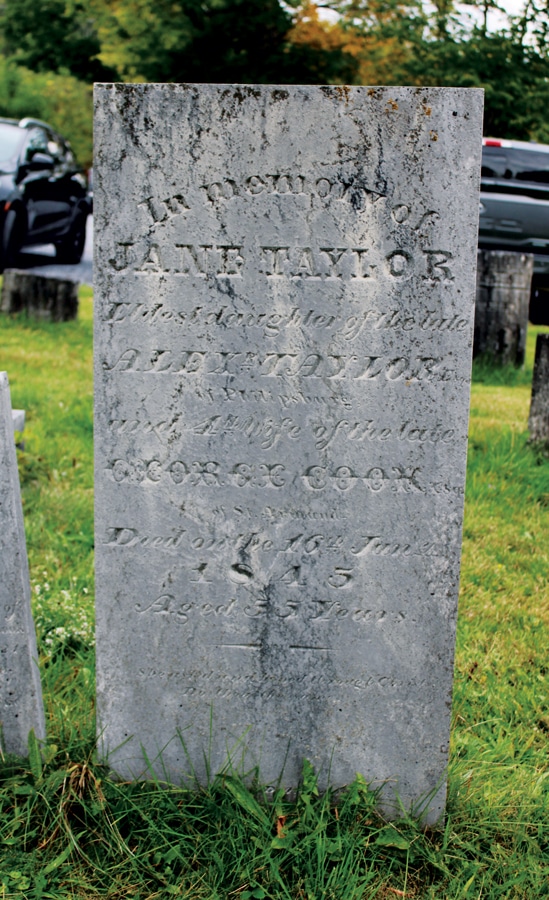
Gravestone of Jane Taylor, Bishop Stewart Memorial Church Cemetery, Frelighsburg. Photo: Heather Darch
On her gravestone, Jane Taylor is identified as the “Eldest daughter of the late Alexander Taylor of Philipsburg and 4th Wife of the late George Cook of St. Armand.” It was very rare for a middle-aged widow to identify a parent on a tombstone. Epitaphs for infants, young children and single women typically mention familial relationships to mothers and fathers. But this inscription begs the question: Why did Jane acknowledge her father on her gravestone twenty years after his passing?
Jane was born at Missisquoi Bay, Quebec in 1789 to Jane Brisbin (1760–1797) and Alexander Taylor (1751–1825). When she was eight years old, her mother died, leaving young Jane in a difficult position. As the eldest daughter in a family of five children, she shouldered the weight of the household duties. Probably at the expense of her childhood and education. And, from that point on, dedicated her life to the care of her father.
Alexander Taylor, a native of Scotland, was in Saratoga, New York when the Revolutionary War began. Although often identified as an early Loyalist of Missisquoi Bay, it is unlikely that he was a “true subject at heart” of the British Crown. Major John Campbell, of Fort St. John (St-Jean-sur-Richelieu), remarked that “Alexander Taylor came to this Province in the year 1775, Sergeant in the Rebel Army and was left by them sick in Montreal, and is still supposed to be attached to their cause.”
By 1777, a settlement near the Fort known as “The Rookery,” was notorious for its illicit sale of liquor to the British troops. Controlling this trade were “low fellows” Alexander Taylor and his business partner John Martin. In 1781, a report stated that “…at the Rookery… the perpetual cause of Drunkenness, rioting and Thievery,” meant that “not a day passes without a Court-Martial and punishment” with“some of the best men…becoming examples of the debauchery.” That same year, Major Campbell complained to his superior that Alexander Taylor was “a nuisance to the army and navy at St. John’s.” By December 1782, the “affair of the Rookery” had been settled when it was disbanded by force.
At the close of the Revolutionary War, Taylor followed other displaced Loyalists to the north eastern shore of Missisquoi Bay in the seignory of St. Armand. Their settlement was unauthorized by the British Colonial officials who wished to keep the “King’s Lands” uninhabited between the seigneuries and the newly established and potentially hostile United States. A series of petitions from the Loyalists requested permission to remain nonetheless. These letters were primarily written by Captain Christian Wehr and signed by notable Loyalist officers including brothers John and Henry Ruiter. Alexander Taylor penned his own request in 1788 affirming that he “and many others are praying for land at Missisquoi Bay.”«
Unfortunately for Taylor, his enterprising efforts of the Rookery were well known to the land commissioners considering the appeals. Most “true Loyalists” eventually received land in 200 acre lots, but Taylor was denied. In the Lower Canada Land Papers dated 1795, commissioners declared that “he is a seditious character and refuses to take the oaths” confirming his allegiance to the Crown. It wasn’t until 1802, that Taylor was granted 200 acres in the Sutton Township. He was likely displeased by the ruling. It removed him from the Bay while his fellow signatories on land petitions received 1200 acres.
By this time, Taylor was a widower with a young family and had little choice but to purchase land in Missisquoi Bay from the seigneur Thomas Dunn. With his home life secured through the work of his dutiful daughter, Taylor was free to pursue his business ventures. Over time, his resourceful ways served him well as he purchased and sold land and businesses including grist mills in Vermont.
After Taylor’s death in 1825, 44-year-old Jane found an opportunity for a different life. She married three-time widower George Cook in 1833. Her life with George, who was 70 at the time of their wedding, lasted a brief two years. Then George died. While she would have been known as Jane Cook until she died, she used Taylor on her stone and gave tribute to the man who was most influential in her life.
Heather Darch
Sources
Vital and Church Records (Drouin Collection), 1621–1968 [database on-line]. Institut Généalogique Drouin ; Montreal, Quebec, Canada;
Bruce Walker, The County of Missisquoi in the Eastern Townships of the Province of Quebec https://www.collectionscanada.gc.ca/obj/thesescanada/vol1/QMM/TC-QMM-51950.pdf
Catherine M. Day, History of the Eastern Townships, 1869.
Cyrus Thomas, Contributions to the History of the Eastern Townships, 1866
George H. Montgomery, Missisquoi Bay, 1950.
Samuel G. Taylor, “How Alexander Taylor Came to the Bay,” In: Rovers, Rebels and Royalists, Vol. 18. Missisquoi Historical Society, 1984.
Missisquoi Loyalists https://vermonthistory.org/journal/misc/MissisquoiLoyalists3.pdf
Calender-Vol-X_Headquarters-Records-WO28_GB-War-Office.pdf
July 25, 1781, Major A. Campbell at Fort St. John to Major R.B. Lernoult, adjutant general enclosing “Muster Rolls of Royalists.”https://loyalist.lib.unb.ca/sites/default/files/Calender-Vol-X_Headquarters-Records-WO28_GB-War-Office.pdf
Land Petitions of Lower Canada, 1764 to 1841, https://recherche-collection-search.bac-lac.gc.ca/eng/Home/Record?app=lanpetlowcan&IdNumber=84659&q_type_1=q&q_1=Taylor,%20Alexander&ecopy=e008727499