

Dressed for the occasion

Un texte de Heather Darch
Paru dans le numéro Été/Summer 2026
Publié le : 29 mai 2026
Dernière mise à jour : 31 mai 2026
The man in the daguerreotype may never be identified, but his photograph reflects his sense of self as a labourer and his pride-of-place.
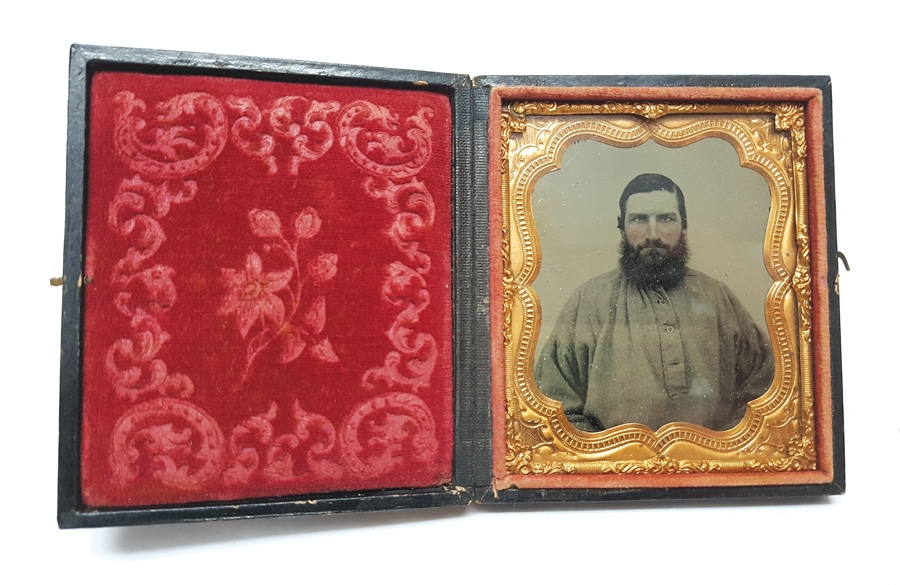
Sometime around 1845, a young man from Missisquoi County decided to sit for a “daguerreotypist” to capture his likeness. The result was a mirror-like, silver surfaced portrait. He looks out at the world with a set jawline, a full beard and neatly parted hair. His daguerreotype image is carefully preserved in a leather case lined in red velvet. Regrettably, like so many early photographs, his name is lost to history. The only certainty we know about him is that he was a manual labourer.
The clue to his status is revealed in his collarless homespun shirt. Linen and woollen work shirts or “smocks” went from being worn as undergarments for nightwear in the Elizabethan era, to daywear during the early 18thcentury. By then, the naturally coloured shirts were worn as a protective garment over clothing and were notable for their “smocking” or pleated stitching. The smocking element eventually disappeared over time, but the style and shape remained. In the industrial era of the 19th century, the work shirt was a common piece of clothing both for rural and factory labourers.
Initially, most working-class attire was made at home. Constructed with dropped shoulders and full sleeves, the pull-over style shirt allowed for a wide range of movement. Relatively small quantities of homespun shirts have survived because they were recycled into quilts and rugs. By the 1860s, factory-made clothing became more available and affordable. The standard men’s working outfit had evolved into a shirt that could be accompanied by a vest, full-length trousers and a cotton scarf for the neck. The shoes and boots were similar to those worn in the 18thcentury, but laces replaced buckles. To top it off, a straw or felt hat provided protection from the weather.
As the 19th century progressed, company brands were developing work clothing, including jeans and jackets. In 1884, the first mail-order catalogue in Canada was published by Timothy Eaton. “Eaton’s” sold men’s everyday work shirts in the pullover style, made from a variety of durable fabrics like chambray, wool and “moleskin” a heavy shaved cotton with the texture of suede.
Work shirts, also called Union shirts, continued to be made without a collar to decrease the likelihood of being caught on hooks, nails, and saw blades or in the steam-powered machinery being introduced on farms and factories. A rigid and detachable collar was used to dress-up work shirts when attending church or other formal events. Our fine fellow decided his work shirt, without a collar, was more than suitable for a photograph.
The introduction of photography meant that for the first time in history, it was possible to document all aspects of life through the lens of a camera. People could appear as they were; giving true likenesses of themselves. As one historian noted, “The photograph became a true mass medium, capturing the likenesses of not just a privileged elite, but large swaths of the middle class.”
The greater affordability and opportunity to have a photograph taken, can be seen when comparing the social status of sitters in the Daguerreotype portraits of the early 1840s with those later in the decade. Sitters in portraits were no longer just from the upper classes. Farmers, shopkeepers, blacksmiths, masons, dressmakers and carpenters all delighted in seeing their face reflected back at them.
By century’s end, occupational portraits became common and both men and women proudly chose to have their lives represented by their professions. They indicated their trades through the items they held in their hands and the clothes they wore. Pictures were even staged to depict a person at work.
For people who lived and worked in a time when self-employed artisans and journeymen were being replaced by the factory system, owning their own photograph meant “demonstrating their individuality and the essential nobility of their work.” It was also a century when people were emigrating away from family and their homeland to escape war, poverty and famine. The opportunity to own pictures of family and friends, was momentous.
Even though the man in the daguerreotype may never be identified, his photograph, taken over 180 years ago, reflects his sense of self as a labourer and his pride-of-place in our region.
Heather Darch
Sources
Rare Historical Photographs https://rarehistoricalphotos.com/tintype-occupational-portraits-19th-century/#:~:text=and%20tin%20snips.-,What%20is%20this?,the%20upper%20classes%2C%20was%20momentous.
Picture This: Library of Congress Prints & Photos https://blogs.loc.gov/picturethis/2017/10/profiling-portraits-occupational-portraits-of-the-19th-century/#:~:text=In%20this%20occasional%20series%2C%20Profiling,%2Dkind%2C%2019th%20century%20format
Annie Rudd, Public Faces: Photography as Social Media in the 19th Century, Public Faces: Photography as Social Media in the 19th Century, https://www.icp.org/perspective/public-faces-photography-as-social-media-in-the-19th-century#:~:text=As%20a%20visual%20image%20meant,a%20century%20and%20a%20half.
Smock Shock: The smock and politics http://www.smockfrock.co.uk/tag/working-class-clothing/Smocks, Smocking, Smocked https://merl.reading.ac.uk/explore/online-exhibitions/smocks/
Jacqueline Beaudoin-Ross, Clothing during the Colonial period https://thecanadianencyclopedia.ca/en/article/clothing-during-the-colonial-period#:~:text=During%20the%2019th%20century%2C%20similar,harsh%20weather%20and%20rough%20countryside.
Douglas McCalla, Textile Purchases by Sorte Ordinary Upper Canadians, 1808-1861 https://journals.lib.unb.ca/index.php/mcr/article/view/17864/22085