

The Grater Spice

Un texte de Heather Darch
Paru dans le numéro Automne/Fall 2026
Publié le : 13 septembre 2026
Dernière mise à jour : 13 septembre 2026
Did you know that the nutmeg grater used to be a status symbol and a very particular fashion accessory well into the 19th century?
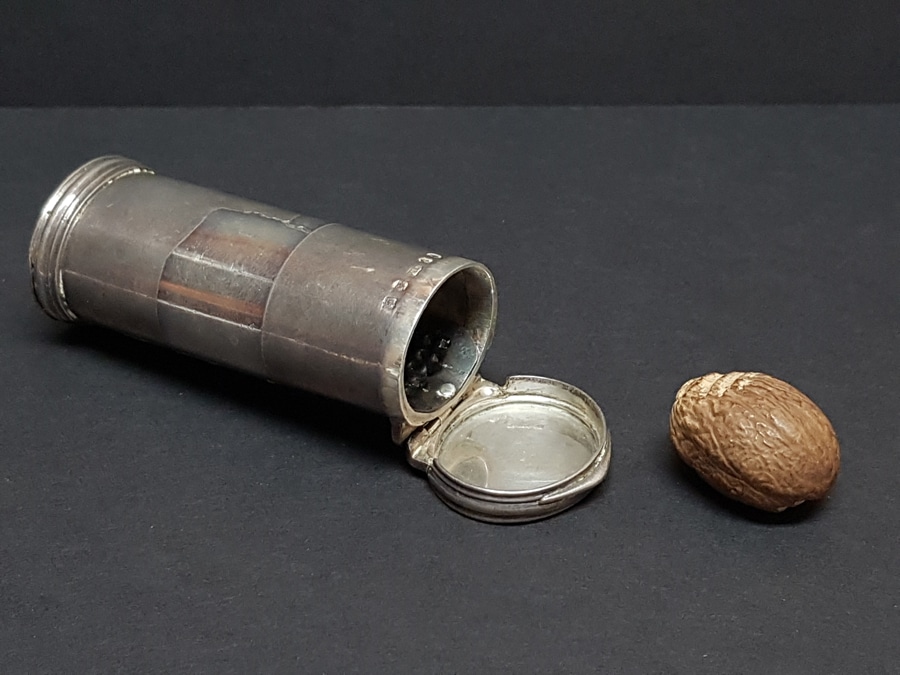
The season of mulled wine and eggnog means that the popular holiday spice of nutmeg takes on a leading role. It has long been added to drinks and dishes to give that distinctive fragrant and warm flavour. At one time though, nutmeg impacted the world on a global scale. It not only created trade conflicts; it was a status symbol for the wealthy, influencing a very particular fashion accessory well into the 19th century.
The Spice
Initially, the nutmeg tree, (Myristica Fragrans), originated from the Banda Islands, now part of Indonesia. It is speculated that the earliest trade in nutmeg transpired with China, but the Romans too, used nutmeg in the first century A.D. for its medicinal healing powers and hallucinogenic effects. In the 6thcentury, Arabian spice caravans brought nutmeg to Constantinople and by the 11thcentury, merchants transported nutmeg to the commercial centre of Venice which then supplied all of Europe. Given that its supposed properties could protect against the plague, the Holy Roman Emperor, Henry VI, ordered the streets of Rome be dusted with nutmeg before his coronation in 1191. The medieval author Geoffrey Chaucer mentions “notemuge to put in ale” in his Canterbury Tales, which was written toward the end of the 14thcentury. By this time, Europe was nutmeg obsessed.
Portugal controlled the exclusive trade in nutmeg for a time until they were ousted by Dutch traders who then dominated the world markets for over two centuries. They sold nutmeg at outrageous prices, knowing that the demand and its rarity, along with the peril to transport it, gave them dominance over the “status-spice.” The competition for nutmeg and for the possession of the nutmeg tree itself, led to acts of piracy, smuggling, slave-plantation economies and genocide.
A Symbol of Sophistication
The spice was so highly coveted by the wealthy classes that clothing and fashion accessories changed to accommodate their fixation. The appearance of personal nutmeg graters in the 1680’s, was concurrent with the emergence of pockets in vests, coats and skirts. For gentlemen in particular, and in the era of “pretty gestures,” having both a pocket and a silver nutmeg grater became a symbol of sophistication. Taking out agrater to spice a meal or beverage, would have been an act of refinement; offering the same to one’s neighbour at the table, would have been “a very pleasing act to witness.” The social custom of carrying a personal nutmeg grater spread throughout all status symbol-seeking societies, including among Quebec’s French and English-speaking elite.
Typical graters were cylindrical, with a silver tube to hold both the rasp for grating and to store one nutmeg seed; later, many other designs were used. It wasn’t until a cross-cultural network of spice traders and formidable rival ventures by the British, that the Dutch monopoly was finally crushed; allowing for wider nutmeg cultivation and trade and everyday use among all classes.
The Grater: A Luxury Object
By the mid-18th century, nutmeg was commonly used to flavour food and alcoholic beverages, such as wine, “negus,” toddies, “syllabubs and flips,” and enhance the elegant drinks of chocolate and coffee. In both Hannah Glasse’s The Art of Cookery, published in 1747, and Mrs. Beeton’s Household Management printed over a century later, everything from eggs and salads, to beans, fish, puddings and buns, was seasoned with “a scrape of nutmeg.”The nutmeg grater even became an indispensable tool of “the serious punch-maker” Charles Dickens. He also carried his grater on midnight walks through the London slums “to sweeten the air.”
As a luxury object, graters reached the height of their popularity in the 1860s. By then, nutmeg was affordable and no longer a spice just for the rich. Thinner-gauge silver, iron and tin graters could also be purchased at reasonable prices. These changes meant that freshly grated nutmeg was enjoyed by all levels of society. A silver nutmeg grater housed in the Missisquoi Museum for example, was once owned by Zebulon Cornell; the proprietor and operator of the Stanbridge East gristmill.
In the mid-20thcentury, society turned to nutmeg already conveniently ground and packaged, thus, reducing the use for fresh nutmeg and graters. Today, antique nutmeg graters are highly collectable items and true devotees of the spice say that nothing compares to freshly grated nutmeg, with the best of the spice still coming from Indonesia.
Heather Darch
Sources:
Kris Manty, The Spicy History of Nutmeg and Nutmeg Gratershttps://www.antiquetrader.com/collectibles/antique-nutmeg-graters
Deborah Blum, A Warning on Nutmeghttps://archive.nytimes.com/well.blogs.nytimes.com/2014/11/25/a-warning-on-nutmeg/#:%7e:text=These%20can%20include%20an%20out,in%20mud%2C%E2%80%9D%20said%20Dr.
The Nutmeg Grater: A Kitchen Collectible, And So Much More. Journal of Antiques and Collectibles. 19 June 2016. http://journalofantiques.com/features/nutmeg-grater-kitchen-collectible-much/
Nutmeg Grater Victoria & Albert Museum collections https://collections.vam.ac.uk/item/O78651/nutmeg-grater-e-robinson-and/#:~:text=British%20Galleries:,punch%20and%20hot%20mulled%20wine.
Edward Hewett and W.F. Axton, Convivial Dickens: The Drinks of Dickens and His Times, Ohio University Press, 1983.https://archive.org/details/isbn_0821407023
Dorit Brixius, A Pepper acquiring Nutmeg: Pierre Poivre, The French Spice Quest and the Role of Mediators in Southeast Asia, 1740s to 1770s,2015. https://quod.lib.umich.edu/w/wsfh/0642292.0043.006/-pepper-acquiring-nutmeg-pierre-poivre-the-french-spice-quest?rgn=main;view=fulltext
Hannah Glasse, The Art of Cookery made Plain and Easy, 1747.https://archive.org/details/TheArtOfCookery
The Cook and the Curator: Cloaked in mystery: nutmeg and macehttps://blogs.sydneylivingmuseums.com.au/cook/cloaked-in-mystery-nutmeg-and-mace/index.html#:~:text=A%20private%20stash,the%20lid%20and%20the%20base.
Mrs. Isabella Beeton, Beeton’s Book of Household Management, 1861.https://archive.org/details/b20392758/page/n3/mode/2up
J. E. Klopfer, The Nutmeg Grater: A Kitchen Collectible, And So Much More, 2016. https://journalofantiques.com/digital-publications/joac-magazine/features/nutmeg-grater-kitchen-collectible-much/